


Power Your Growth

hello@propensity.com
Advertising budgets aren’t infinite. Every marketing team has to decide where their spend will have the greatest impact.
That’s why many marketers end up comparing programmatic advertising vs Google Ads. But that comparison can be misleading because Google Ads includes multiple ad formats, including search, video, and display.
In practice, when marketers search for programmatic advertising vs Google Ads, they’re usually trying to understand the difference between programmatic and Google Display advertising.
Both approaches automate digital advertising and help brands reach target audiences at scale. But they operate very differently when it comes to reach, targeting flexibility, data signals, and campaign control.
In this guide, we break down how programmatic advertising compares to Google Display so you can determine which approach best supports your advertising strategy.
The Google Display Network is a closed display advertising ecosystem owned and operated by Google. Campaigns are created inside Google Ads and appear across participating publisher sites and apps within Google’s network.
Advertisers can run multiple types of Google Display ads, including:
Depending on the campaign type, you can target audiences using:
Google Display ads are purchased and managed within the Google Ads platform, making them easy to launch for teams already running search campaigns.
While Google Display automates ad placement within Google’s ecosystem, it still operates inside a single advertising network. Programmatic advertising, by contrast, allows advertisers to buy media across multiple exchanges and publishers in real time.
Programmatic advertising is an automated way of buying digital advertising across multiple ad exchanges and publishers in real time. Instead of operating inside a single advertising network, advertisers use demand-side platforms (DSPs) to access inventory across the open web.
Programmatic channels include:
Instead of targeting based on keywords or static demographics, programmatic buying evaluates each impression as it becomes available, matching ads and placements in real time. This means ads can take contextual data into account when targeting.
Programmatic advertising and Google Display share some core features—both automate ad delivery and help brands reach large audiences. But for B2B teams focused on pipeline generation and account engagement, the differences between the two approaches become significant.
At a high level, the difference between programmatic advertising vs Google Display campaigns in Google Ads comes down to reach, flexibility, and data transparency.
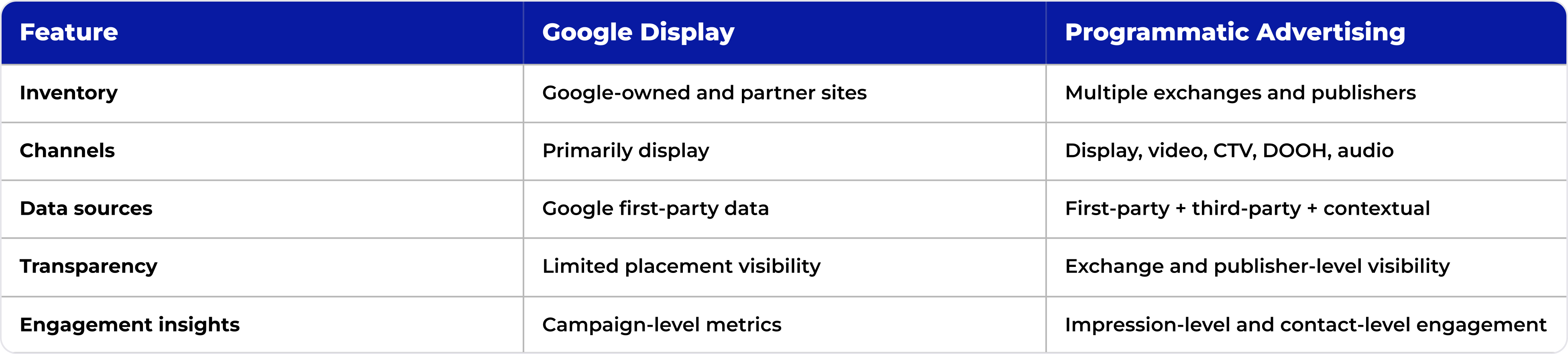
Google Display: You’re limited to Google’s inventory. While this includes over 2 million websites, Google Display is primarily limited to traditional digital channels.
Programmatic: Instead of being tied to a single platform, you can access inventory across multiple ad exchanges and premium publishers. Programmatic offers a broad range of use cases. You can reach a broader audience and gain deeper control over where your ads appear, including in video, DOOH, connected TV, and other channels.
Key difference: This is one of the primary differences between programmatic and Google Display. If you want to run omnichannel campaigns with Google Ads, you need to manage other channels manually, on other platforms. Programmatic empowers you to run ads in more formats across channels, all in one platform.
Google Display: Google Display targeting is powerful but largely reliant on Google’s first-party data and predefined audience segments. You can’t easily layer on external third-party data.
Programmatic: Programmatic platforms are more data-flexible, enabling the use of both first- and third-party behavioral, demographic, and contextual data. This gives you greater granularity and control over audience targeting, creative placements, and retargeting.
Key difference: With programmatic advertising, you can implement more sophisticated targeting strategies, such as contextual targeting and geofencing, because you have access to more granular data.
Google Display: With Google Display advertising, you have broad targeting capabilities but limited control over (or transparency into) where your ads actually appear, auction data, and reporting segmentation.
Programmatic: Programmatic platforms provide deeper visibility into impression-level data, audience behavior, and publisher performance. This allows marketing teams to move beyond surface-level advertising metrics and understand how campaign exposure influences real buyer activity.
More advanced platforms can also surface contact-level engagement data, showing which individuals from target accounts have been exposed to or interacted with advertising. Platforms like Propensity enable this level of visibility, giving marketing and sales teams a clearer view into who is actually engaging with campaigns.
Key difference: To protect their algorithms, Google limits transparency into placement context, auction mechanics, and user-level engagement signals. Programmatic platforms generally provide deeper reporting and more granular insights into where ads appear, how audiences interact with them, and how engagement connects to downstream buying activity.
Google Display: Google Display operates within Google’s auction environment, where you can bid on ads on a cost-per-click (CPC) or cost-per-thousand (CPM) basis. You can adjust bids and budgets, but you’re still operating inside Google’s algorithm. You have limited visibility into how inventory is priced and limited control over auction mechanics.
Programmatic: Programmatic advertising functions across various open exchanges and private marketplaces at the same time, resulting in a more competitive and adaptable pricing landscape. Moreover, deal types such as programmatic guaranteed, which set fixed prices for a specific number of ad impressions, provide additional pricing choices.
Key difference: Overall, Google Display offers a standardized approach to ad pricing, with limited ability to influence the pricing logic. Programmatic supports a wider range of pricing strategies and optimization approaches, giving you more flexibility.
Google Display works well for teams that want a simple, accessible way to launch display campaigns without managing multiple platforms. Because it’s built directly into Google Ads, it allows marketers to quickly extend existing campaigns into display advertising.
For many organizations, Google Display serves as an easy entry point into digital advertising before expanding into more advanced programmatic strategies.
If you’re a B2B brand new to advertising and you’re looking for simplicity, speed, and accessibility, Google Display is a good place to start. Because it’s built directly into Google Ads, you don’t need to onboard and learn a new platform.
This makes it effective for:
If retargeting is your primary goal, Google Display is highly effective. It seamlessly integrates with Google platforms, allowing you to retarget YouTube viewers, people who have seen your other ads, and website visitors to strengthen your message.
This is especially valuable for:
Google Display is often an extension of an existing Google Ads strategy. Especially if Google Ads is your only platform, it may make sense to keep all your advertising efforts in a single platform, using a single data set.
This enables you to:
For many B2B teams, programmatic advertising becomes the foundation of their broader advertising strategy. Instead of running isolated campaigns inside individual platforms, teams can centralize audience activation, campaign orchestration, and performance insights in a single environment. This creates a more coordinated approach to advertising that supports both marketing awareness and sales engagement.
Traditional display advertising measures campaign success through surface-level metrics like impressions and clicks. But B2B buying journeys are long, complex, and involve multiple stakeholders.
Programmatic platforms can provide deeper insight into who is actually engaging with your campaigns. Advanced platforms surface contact-level engagement data, showing which individuals from target accounts have seen or interacted with ads.
This enables marketing and sales teams to:
Instead of treating advertising as a top-of-funnel awareness channel, programmatic allows B2B teams to use advertising as a signal engine for pipeline creation.
Programmatic platforms are built for the level of precision B2B teams need when running account-based marketing (ABM). Instead of targeting anonymous segments, you can activate named accounts, prioritize high-intent contacts, and coordinate omnichannel engagement aligned with sales outreach.
Unlike single-network buying, programmatic empowers you to:
One of the main advantages of programmatic advertising is its capacity to coordinate omnichannel campaigns. These campaigns aren’t restricted to banner ads; they can also run across digital platforms, CTV, audio, and DOOH channels.
This helps you achieve:
B2B campaigns can bloat quickly. Programmatic enables optimizations beyond surface-level metrics (like click-through rate), adjusting budgets and buying strategy based on a wider range of data points. This ensures your investments are supporting real sales outcomes, not just vanity metrics.
Controls include:
It doesn’t always have to come down to Google Display vs. programmatic. Many companies use both as complementary levers.
Both approaches play a role in modern B2B advertising strategies. But as organizations mature their demand generation programs and focus more heavily on pipeline impact, many find that programmatic becomes the foundation for scalable, omnichannel advertising.
Programmatic breaks you out of the traditional single-network trap. It gives you the ability to activate genuine buying signals, control where and how your brand appears, and build holistic campaigns in a single platform.
For B2B teams focused on measurable growth, programmatic often becomes a strategic evolution beyond single-network advertising.
If you want to see how contact-level programmatic can translate exposure into real pipeline signals, book a personalized demo to explore how Propensity works.

%201.svg)