How to use contextual targeting in your ABM strategy
The power of account-based marketing (ABM) lies in its laser focus on particular companies and contacts. By zeroing in on specific, high-value accounts, you can deliver the kind of personalized messaging that resonates with buyers at the middle and bottom of the sales funnel.
But ABM alone only works if your target accounts already know you. Without top-of-funnel awareness, even the best-targeted ABM campaigns struggle to gain traction. That’s where contextual targeting comes in: building awareness with buyers whose interests already align with what you offer. Think of contextual targeting as a top-of-funnel partner for ABM, meeting potential buyers where they are and bringing them into your mid- and bottom-funnel efforts.
Quick overview: what contextual targeting is and how it works
Contextual targeting is a strategy for placing ads on web pages with content related to the ad. Your ads appear on pages with topics and keywords relevant to what you're promoting and what your audience is interested in. This approach ensures your ads appear where they’re actually relevant to the people you want to reach.
Relevance is the name of the game in contextual targeting. You want your ads to appear on pages that are closely tied to both your brand and your audience’s interests. Choosing the right keywords ensures your ad placements are married to content that resonates.
In-context keywords
In-context keywords (also called included phrases) are specific words and phrases on webpages where you want your ad to appear.
If you’ve been using ABM, you already know your buyers intimately: not just who they are, but the pain points and niche business problems they need to solve. Leverage that insight to identify in-context keywords that make sense for your contextual targeting campaign.
Pro tip: Relevance hinges on the right level of specificity. Use long-tail keywords that accurately reflect the topics your audience is looking for.
Out-of-context keywords
Relevance isn’t just about where your ads show up—it’s also about making sure they don't wind up on the wrong pages. Out-of-context keywords (also called excluded phrases) prevent your ads from surfacing next to content that doesn't align with your intent.
Look at your in-context keywords and consider what unintended associations they might have. Words with more than one meaning, terms that might show up in negative news coverage—think broadly about different contexts where keywords might appear.
Use cases: contextual targeting vs. ABM
Contextual targeting gets your brand front-and-center when prospects are in the right mindset to engage. They come to you. ABM flips the direction: you identify the accounts you want to reach before creating campaigns.
But each approach has distinct use cases. Knowing when to use contextual targeting vs. ABM (or both together) is key to crafting an effective, holistic marketing strategy.
Contextual targeting use cases
With contextual targeting campaigns, you don’t know the identities of the people you reach. Contextual campaigns make most sense when you don’t have specific contacts to target—or your best prospects don’t know who you are.
Brand awareness: You may offer the perfect solution to a buyer’s needs. But it's a moot point if they don’t know you exist. Contextual targeting is highly effective at building brand awareness, especially if your market is dominated by a few well-known players.
New market entry: When you expand your reach, you need to raise awareness with a whole new audience. Use contextual targeting when you’re entering a new geographic region, adding a fresh business line, or targeting an unfamiliar market segment.
Competitor conquest: If people are talking about your competitors, you want in on that conversation. Use contextual targeting to show ads alongside articles and videos about your key competitors. Be sure to highlight what makes you a compelling alternative.
Event promotion: Conferences, trade shows, industry awards—high-value contacts are there, and you should be too. Contextual ads can drive booth traffic, establish a digital presence if you won’t be there in person, and reinforce awareness after the event. Case in point: AWS re:Invent. The conference dominates tech reporting for weeks; it’s a perfect time for software and engineering firms to target people reading that coverage.
ABM use cases
ABM makes sense when you know the accounts and targets you want to win over. It drives efficient efforts that connect with high-intent leads.
Known target account lists: Focus campaigns on the companies whose business makes the biggest impact on your bottom line. Even better: drill down into contact-level intent to reach the actual decision-makers on your accounts list.
Pipeline acceleration: An effective pipeline is filled with people aligned with your market strategy and with high purchasing intent. Use ABM to reach high-value prospects at the right time to accelerate pipeline movement and close rates.
Deal expansion: Your existing customers are also an indispensable marketing audience. Use ABM strategies to increase the value of your current accounts with retention, cross-sell, and upsell campaigns.
How contextual targeting and ABM strategies work together
Combining contextual targeting and ABM gives you a full-funnel strategy. Build awareness and fill your pipeline with contextual targeting; nurture contacts into bottom-of-funnel behavior with ABM.
Contextual targeting can reinforce active ABM campaigns by surrounding target accounts with relevant messaging as they research competitors, industry trends, or solution categories across the open web. It also creates early engagement signals that inform how you prioritize outreach and budget allocation within your ABM strategy.
Use contextual targeting to fill the funnel for ABM
You know who your target accounts are for ABM strategies. But do they know who you are? Contextual targeting establishes brand recognition and starts the relationship you need for effective ABM efforts.
Build awareness: ABM efforts are more effective when your target accounts are already familiar with you. The more buyers that see your brand in relevant contexts, the stronger that recognition grows.
Establish trust: As your audience is looking at interesting content, they see your ads right alongside it. That association creates a foundation of trust, assuring buyers that what you offer matters to them.
Identify contacts: When people click on your contextual ads, they come to your site as unidentified users. That’s your chance to turn anonymous visitors into known contacts. You know these visitors’ interests based on the content that led them to you. Use contact-level website tracking to learn exactly who they are: identity, role, and company.
Pro tip: Connect traffic from contextual targeting ads to your sales workflows. That way, your sales teams can take timely action to capitalize on user engagement.
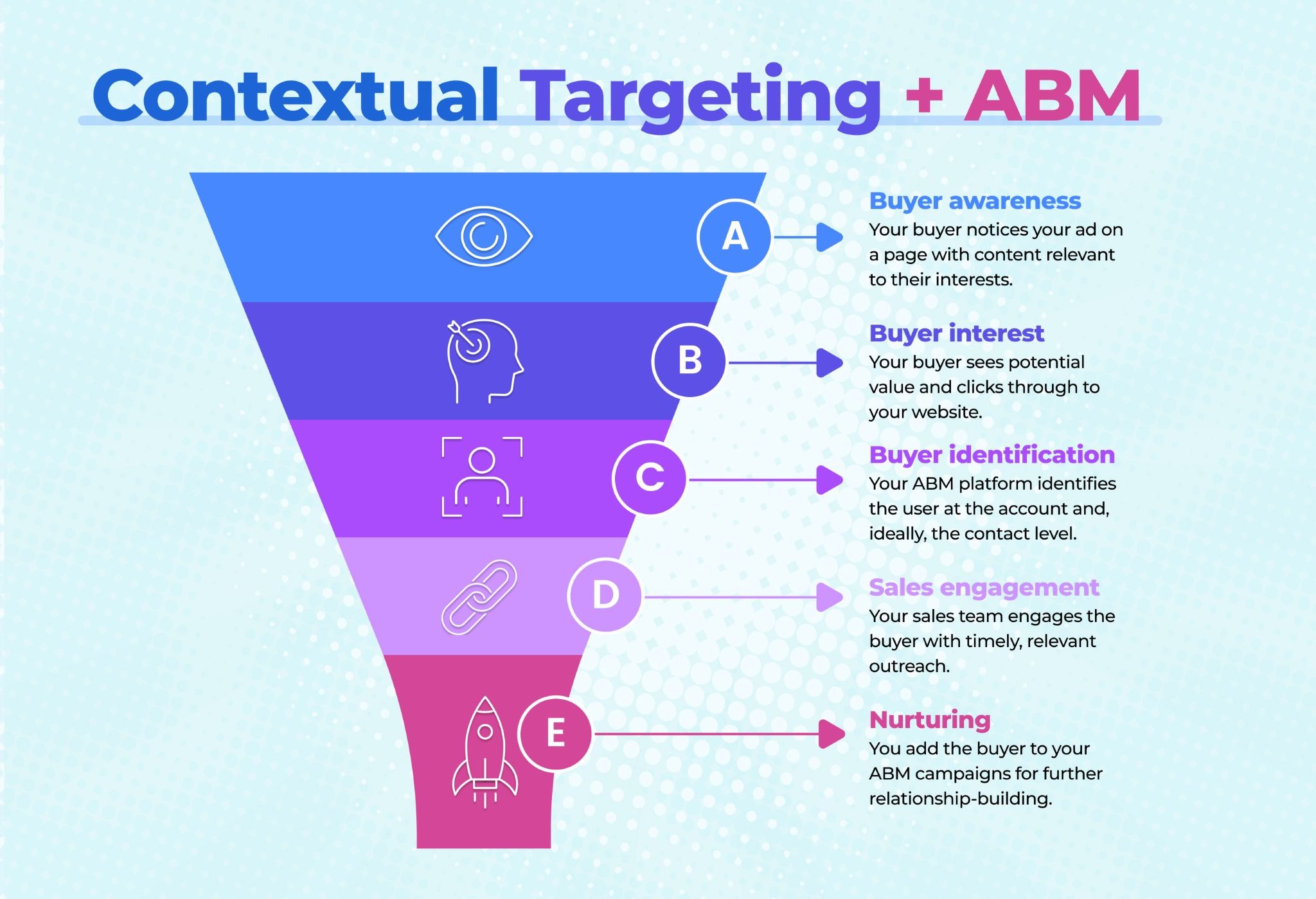
Model funnel: contextual targeting + ABM
Here’s how a buyer’s journey through the funnel might look when you combine contextual targeting and ABM strategies:
Buyer awareness: Your buyer notices your ad on a page with content relevant to their interests.
Buyer interest: Your buyer sees potential value and clicks through to your website.
Buyer identification: Your ABM platform identifies the user at the account and, ideally, the contact level.
Sales engagement: Your sales team engages the buyer with timely, relevant outreach.
Nurturing: You add the buyer to your ABM campaigns for further relationship-building.
How sales benefits from contextual targeting
To get the most from contextual targeting, bring sales into the mix. Contextual campaigns give sales teams a wealth of intel they need to maximize their outreach and close deals successfully.
High-value known contacts
Someone who clicks on a contextual ad may be anonymous at first, but they’re a warm lead. Once you identify who those visitors are, sales teams can drill down to see:
Account-level intel: Which companies visited your website and whether those accounts are already on your target list.
Contact-level info: De-anonymized traffic surfaces actual people for sales outreach. You can send actionable contacts straight into your CRM for rapid sales action.
Contact behavior: Sales teams can track the pages each visitor viewed on your site to score their level of warmth and purchase readiness.
Known contacts: Someone who’s already in your database signals especially high engagement when they click one of your ads. That’s a big green flag for sales to step up engagement.
Buyer intent and interest insights
Generic outbound prospecting takes a lot of effort, but provides little ROI. Contextual targeting surfaces insights that sales can use to craft personalized messages that resonate.
Buyer interests: Sales can see exactly which webpages drove a contact to your site. They can tailor outbound messaging precisely to reflect the topics and themes buyers have proven they’re interested in.
Buyer intent level: The kind of keywords that drive ad traffic reveal how purchase-ready a prospect may be. Ad traffic from informational pages can signal leads who need a softer touch. Sales can prioritize high-intent leads who came from commercial or transactional keyword campaigns.
Strategic timing and messaging
Right person, right time, right message: the three foundations for successful outbound sales. Contextual targeting equips sales with data to drive strategic outreach.
Strategic timing: Your contextual ad motivated buyer action; rapid sales follow-up capitalizes on that momentum.
Relevant messaging: Equipped with insight about the context that brought a lead to your site, sales can deliver hyper-personalized messaging that hits the bull’s-eye.
Pro tip: Contextual targeting can drive sales prospects, but it’s not intended to magically generate lead lists. Set campaign goals that encompass awareness and engagement metrics at the top of the funnel.
How to operationalize your contextual targeting + ABM strategy
Now that you know the how and why behind contextual targeting, let’s walk through how you can put it into practice.
Set yourself up for full-funnel operations
Before you launch, ensure you’re equipped to translate ad traffic into pipeline and nurture leads:
Ensure tracking and attribution: Install contact-level website tracking so you can de-anonymize visitors. Be sure your account-level tracking is also well calibrated so you can gather insights from users who opt out of cookies.
Assess your channels: An omnichannel strategy increases your visibility and ensures you reach people across platforms. Review the channels you’re using and look for opportunities to expand based on where your target buyers spend time.
Select keywords: Identify three to five in-context keywords. Think about these from a buyer’s perspective: what business topics are they actually interested in right now?
Identify out-of-context keywords: If you’re unsure what to exclude, search the in-context keywords you’ve chosen to see what irrelevant or off-message content comes up.
Review sample URLs: Your marketing platform should surface some sample links where your ads might appear. This is your chance to validate that your keyword choices are on point—and refine them if needed.
Nurture and optimize
Once your contextual targeting campaign is live, it’s time to build on your success:
Retarget visitors with ABM campaigns: Contextual targeting meets people at the top of the funnel. Reinforce awareness and nurture interest with sequential retargeting display, social ads, and omnichannel marketing campaigns.
Review and optimize campaign performance: Digital content is constantly evolving, and your contextual targeting will shift along with it. Evaluate performance frequently and update your campaign to maintain relevant context and capitalize on the best-performing themes.
Get hands-on with contextual targeting and ABM
Leveraging contextual targeting with ABM is a powerful strategy—and it’s even more effective when your marketing platform brings them both together. Propensity is built to go beyond legacy ABM platforms, with end-to-end omnichannel campaigns for ABM, contextual targeting, and more.
Let our experts walk you through exactly how to use Propensity for your strategic goals. Book a demo now!

.png)



%201.svg)