.jpg)


Power Your Growth

hello@propensity.com
.jpg)
Events are one of the most valuable moments in B2B marketing, but also one of the most competitive.
Buyers attend events to learn, compare solutions, and make shortlists. But attention is limited. Every booth competes for visibility. Every session pulls focus.
Teams that win at events don’t rely on chance conversations or post-event lead lists. They approach events as a full-funnel buying journey, with coordinated strategies before, during, and after the event. And with a focus on the entire buying group, not just badge scans.
In this guide, we’ll walk through a modern event strategy built on precise targeting, real-time intent, and continuous engagement, showing how B2B teams can turn short-term event interest into long-term pipeline.
Decision-makers attend events with intent. They’re there to evaluate, learn, and move buying decisions forward. But attention is limited, and generic outreach quickly gets ignored.
Teams that succeed don’t rely on chance interactions or single-channel tactics. They use targeted marketing strategies that combine account focus, contact-level visibility, real-time intent, and timely engagement, ensuring the right people see the right message at the right moment.
Events don’t respond well to one-dimensional approaches. Relying on ABM alone, or only running ads to attendee lists, leaves gaps across the buyer journey.
A high-impact event strategy brings multiple capabilities together:
When these elements work together, marketing shifts from chasing volume to guiding meaningful conversations, booking better meetings, and adding real intelligence to the pipeline.
High-performing event strategies apply this targeted approach across the entire event lifecycle—before, during, and after the event.
Rather than treating each tactic in isolation, teams connect them into a coordinated system that adapts as buyer behavior changes. The result is stronger visibility, better prioritization, and clearer insight into what’s actually driving engagement and revenue.
Running this kind of event strategy isn’t impossible without a unified platform, but executing it consistently, at speed, and at scale is difficult.
Most teams rely on a patchwork of tools: separate ABM platforms, disconnected ad channels, limited event data, and delayed post-event reporting. That fragmentation makes it hard to act on intent while it matters.
Propensity brings these capabilities together in one system, making it easier to execute a coordinated event strategy from start to finish.
Different parts of Propensity’s toolkit play pivotal roles at various stages of your event strategy. The strongest results come from treating events as a continuous journey, not just a quick attention spike. Go beyond attendance. Consider the event build-up and the weeks that follow as well. This ensures you’re capturing every opportunity that presents itself.
Pre-event strategy sets the stage for event success. Teams that build awareness early arrive with momentum already in place.
When attendee or registration lists are available, upload them directly into Propensity. When they aren’t, start with the list of attending companies.
From there, Propensity identifies the right contacts within each account and extends to the full buying circle. That means reaching influencers, champions, and key stakeholders, not just attendees who may or may not be decision-makers.
Not every buyer registers early. But many companies research sessions, speakers, and topics weeks in advance.
Contextual campaigns let you reach buyers searching for event themes, category keywords, and problem statements tied to the show. By starting early, you’ll be capturing interest even when formal attendee data is incomplete.
ABM campaigns build familiarity before attendees arrive. Target contacts across paid social, display, and search with event-related messaging.
Remember to highlight booth location, session speakers, or specific use cases aligned to the event audience. When buyers recognize your brand on the show floor, you’ll get conversations flowing faster.
Events don’t start at the convention center. They start at the airport.
Geofencing airports, hotels, and host cities allows you to build recognition as attendees travel. That early exposure increases booth traffic once the event begins. Targeting is tactical. Check the event website for a list of preferred hotels and research planned off-site events. Understanding attendees' likely travel patterns can help you geofence effectively.
Propensity’s Contact Website Tracker adds a critical layer of intelligence before the event.
It reveals anonymous visitors tied to ICP companies or attending accounts and shows what they’re researching. You can see which pages they viewed and how they found you, for example, through ABM ads, contextual keywords, organic traffic, or geofence exposure.
Those early engagers can be added automatically to targeted campaigns. The bonus: sales gains visibility into what prospects care about before conversations begin, making it easier to book meetings in advance.
By getting in early and planting your flag, you’ll already have an advantage over the competition in the form of:
Once the event starts, attention fragments quickly. Staying visible requires timely relevance.
During events, buyers research between sessions. Luckily, the Contact Website Tracker captures those moments.
You can track traffic spikes, see which contacts revisit product pages or demo content, and understand who is actively evaluating. Propensity shows which campaign type (ABM, contextual, or geofencing) drove each visit.
That intelligence gives sales real-time context on who to prioritize while they’re still on the floor.
Once the conference is in full swing, geofencing around the venue keeps your brand top of mind during peak show hours. Mobile ads reach attendee devices within a tight radius and reinforce awareness when it matters most.
Use this window of time to promote booth activities, live demos, or meetings without competing for inbox attention.
Contacts who engage during the event need your attention now, not later.
Propensity builds dynamic audiences of visitors showing on-site interest and retargets them with personalized ads or meeting invitations. Sales can prioritize walk-up conversations with informed context instead of cold introductions.
Consistent visuals matter. When ad creative matches booth signage and sales collateral, recognition happens instantly. With clear consistency, trust can build faster, even in a noisy environment.
With a strong digital connection to a physical space, your in-person footprint will be more visible, even in a sea of booths or a crowd of attendees. By merging the physical with the digital, you’ll notice:
Events don’t end when the floor closes. Most buying decisions happen afterward.
The Contact Website Tracker shows who returns to your site after the event and what they engage with. You see which assets, pages, and topics matter most.
That insight allows teams to tailor follow-up, segment audiences by behavior, and streamline meeting booking based on clear buying signals.
Not every decision-maker will attend an event. But post-event expansion adds non-attending stakeholders from attendee companies into your ABM lists, ensuring the whole buying group stays engaged.
Using the Contact Website Tracker and campaign data, audiences can be tagged as:
By dividing into hot, warm, and cold segments, each group can receive messaging tailored to its readiness level.
Contextual targeting continues to surface buyers researching related topics after the event. Educational content keeps your brand top of mind as decisions take shape.
ABM retargeting sustains momentum for weeks or months. Late-stage buyers stay engaged, and the pipeline continues to build beyond any typical event spike.
By being vigilant long after the event wraps, you’re not closing the door on any opportunity. Continued outreach ensures:
Targeted marketing ensures precise, personalized outreach to the contacts that matter most.
For example, a team might use ABM to send tailored invitations to key decision-makers from target accounts before an industry conference. Contextual campaigns can expand reach into active demand not yet identified; a marketing team could launch advertisements related to conference topics to engage new prospects who are actively searching for solutions. Geofencing has the ability to capture attention at peak moments, such as deploying mobile ads to attendees’ devices when they enter the venue. Our Contact Website Tracker closes the loop with full-funnel intelligence by revealing which visitors from attending companies engage with specific content during and after the event, enabling timely and individualized follow-up
Together, they provide a shared source of truth for marketing and sales. Here’s the combined advantage:
Here’s an example of how to lay out an effective, all-encompassing strategy that covers the entire lifecycle of an event and leverages all aspects of Propensity:
4–8 weeks before the event
2 weeks before the event
During the event
1–8 weeks after the event
Most event strategies fall short not because teams lack effort, but because they rely on outdated assumptions about how buyers engage at events.
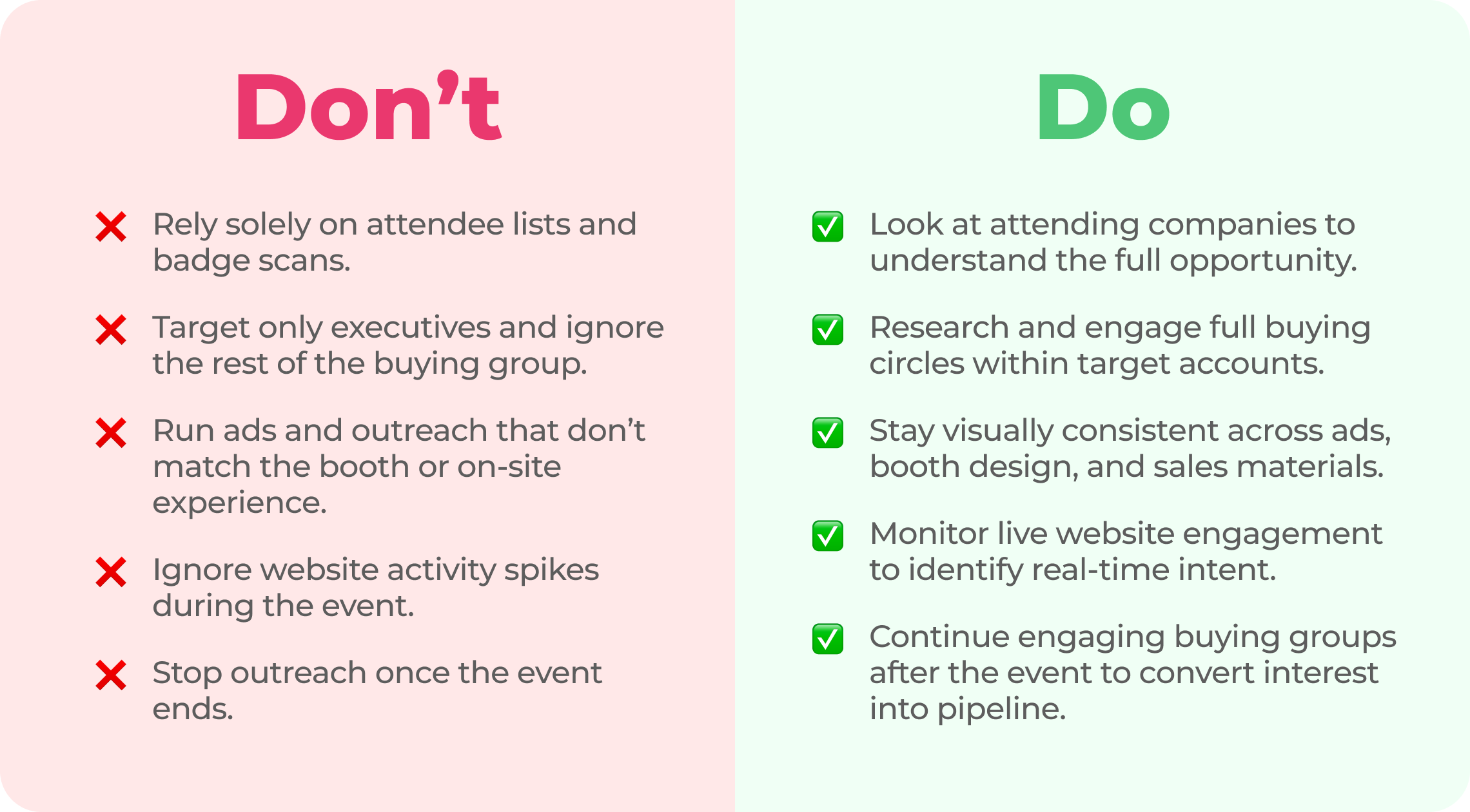
Events are most effective when aligned with a larger strategy. Propensity helps B2B teams reach the right buyers earlier, stay visible during peak attention, and convert interest long after the event ends.
With ABM, contextual targeting, geofencing, and website de-anonymization working together, every event becomes an opportunity to build momentum…and measurable revenue.
If you’re gearing up for your next event, book a demo to see how a high-impact, contact-level event strategy comes to life with Propensity.

%201.svg)