

Power Your Growth

hello@propensity.com
Geofencing is often seen as an awareness tactic. But its real power lies in being one of the most direct ways to generate net-new sales pipeline.
Traditional pipeline generation relies on buyers raising their hands through form fills, demo requests, or event scans. But those signals arrive too late. By then, buyers have already done significant research on their own.
Real-world behavior shows up earlier. Where people go, such as offices, conferences, campuses, or airports, reflects what they are working on and what problems they are trying to solve. Savvy sales and marketing teams know that to capture intent early, you need visibility into real-world behaviors at the contact level. That is where geofencing shines. It captures these early signals and turns that intent into sales-ready opportunities, even when you do not have a preliminary list to build from.
Geofencing creates pipeline by starting with intent instead of identity. Instead of targeting people you already know, you reach buyers based on where they are and what that location represents.
Pipeline-driven geofencing works at a high level by:
A simple contact-level pipeline flow looks like this:
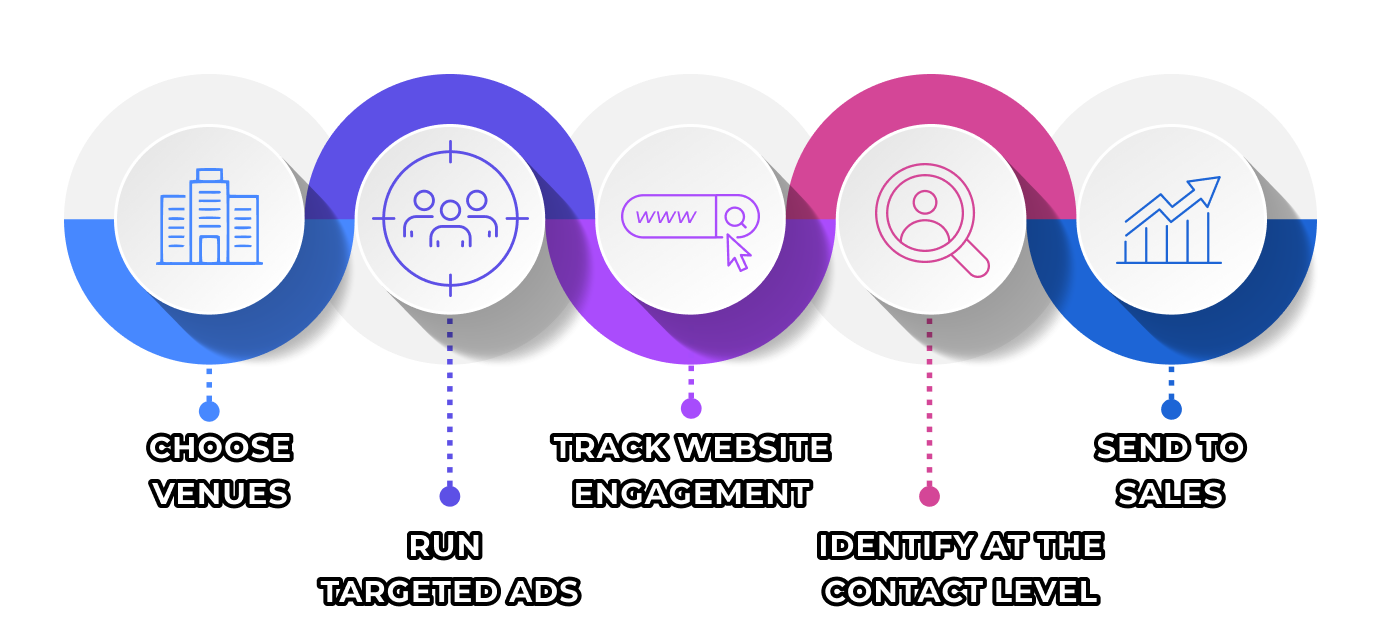
This approach lets teams capture buying signals before prospects fill out a form. It’s also how proximity turns into a pipeline.
Depending on your strategy or sales goals, you can implement geofencing in several ways to focus your pipeline. Here are six to consider.
Geofencing is an efficient way to generate pipeline in specific cities, neighborhoods, or service areas where you operate. Instead of spreading your budget across a broad national campaign, teams can focus spending on markets that matter.
It creates a pipeline by:
For example, a large services marketplace can run geofencing campaigns in select metro areas to promote local professional services. As the pipeline grows or contracts in each city, the team can adjust coverage in real time, keeping spend efficient and outcomes predictable.
Events concentrate high-intent buyers in one place, making them ideal for pipeline-driven geofencing. Instead of relying solely on booth traffic or badge scans, teams can reach attendees before, during, and after the event.
It helps build your pipeline by:
For example, during an industry conference, a B2B company might geofence the event location and nearby hotels and airports. Attendees see demo or content ads. Engaged visitors are identified and routed to sales during and after the event. What was once just brand exposure becomes a measurable and actionable pipeline.
Want to go deeper? Read our complete guide on using geofencing for events →
Not all buying signals come from one-time events. Many come from recurring locations where people work daily.
Geofencing is especially effective around:
It allows teams to stay visible in environments tied to ongoing operational needs. Repeated presence in these locations can reinforce your brand while addressing business pain, budget ownership, and active initiatives.
This strategy is especially effective for SaaS, IT, security, HR, operations, finance, and logistics solutions. The pipeline impact comes from consistent exposure to multiple stakeholders in the same organizations, not just a single contact.
An IT security vendor, for example, might geofence city blocks with concentrations of financial services buildings to engage compliance and security teams across multiple firms at once.
ABM doesn’t always start with perfect data. Geofencing helps you expand named accounts even when employee lists are incomplete or outdated.
With geofencing, you can:
This broadens influence and uncovers new contacts inside accounts you already care about, without requiring new lists.
The pipeline outcome is clear: more identified contacts inside high-value accounts and increased entry points for sales conversations. This makes geofencing a powerful layer for ABM programs that require further reach without sacrificing precision.
Entering a new region is often slow without local brand recognition, events, or field teams. Geofencing accelerates early pipelines by targeting areas with professional density where business activity exists.
Geofencing helps you generate an early-stage pipeline by targeting:
When you pair location-based targeting with region-specific messaging, you can build relevance fast. This helps you gain traction in new markets or test them, even before formal expansion efforts are in place.
Geofencing becomes even more effective when it’s aligned directly with sales activity.
Use it to support:
Location signals help sales teams prioritize who to reach out to and when. This alignment leads to warmer conversations and faster movement through the pipeline.
Ad impressions alone don’t create a pipeline. Actionable data does.
Propensity connects geofencing engagement to website activity and contact-level identification so sales can act with confidence. Instead of anonymous clicks or account-level insights, teams get:
These signals move directly into CRM and sales workflows, turning location intent into next steps. Instead of guessing at triggers, teams can act on verified intent.
Geofencing gives sales teams clearer prioritization and stronger context. Reps can use geofencing data to:
When outreach reflects where buyers have been and what they care about, conversations start warmer. This will propel your pipeline forward.
While geofencing helps target high-quality leads, following a few basic best practices helps you maximize results:
💡 Remember: no matter how targeted your approach is, to be successful, you need to treat geofencing as one tool in a broader pipeline strategy, not as a silver bullet.
Geofencing introduces actual behavior and timely geographical presence into your pipeline strategy. It helps teams reach buyers earlier, prioritize smarter, and convert faster, without waiting for forms, lists, or events to show who may be interested in your product. The faster you capture intent, the faster you can start having conversations that convert.
Book a demo focusing on pipeline creation use cases to see how Propensity turns location intent into revenue.

%201.svg)